القديس بطرس والديك
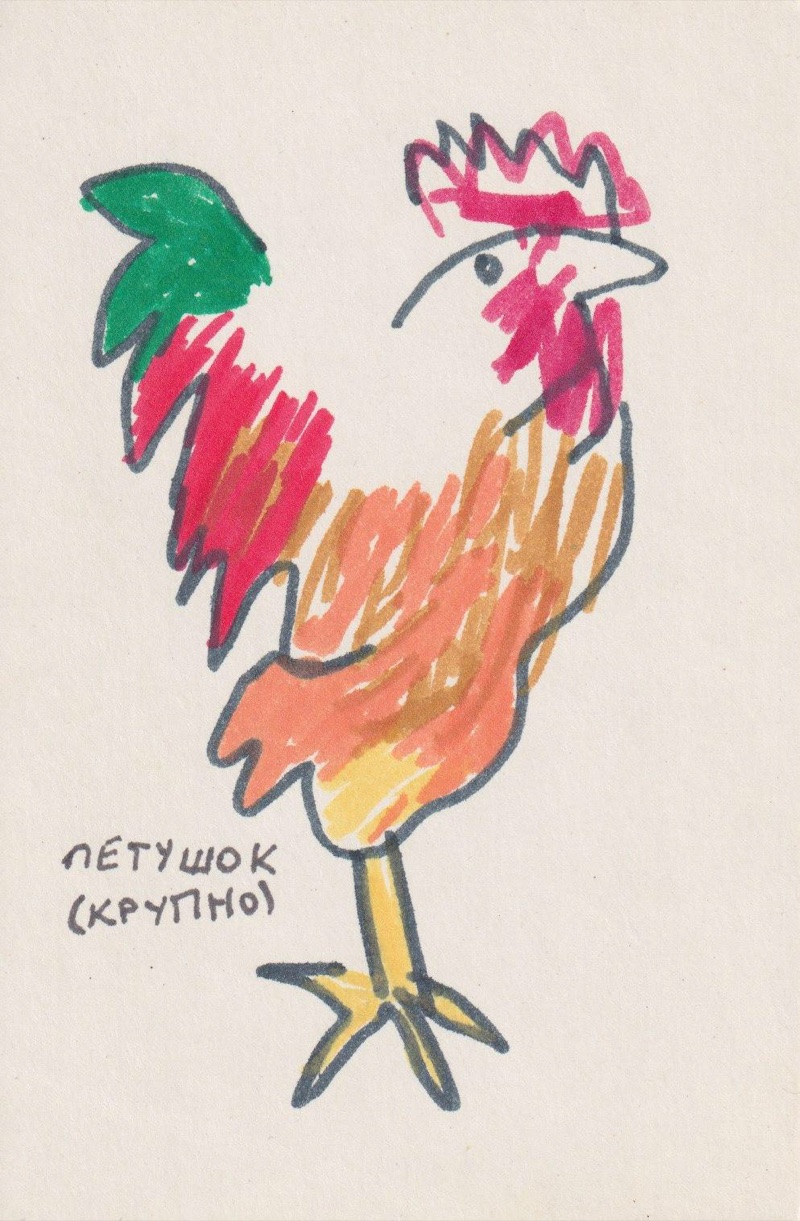
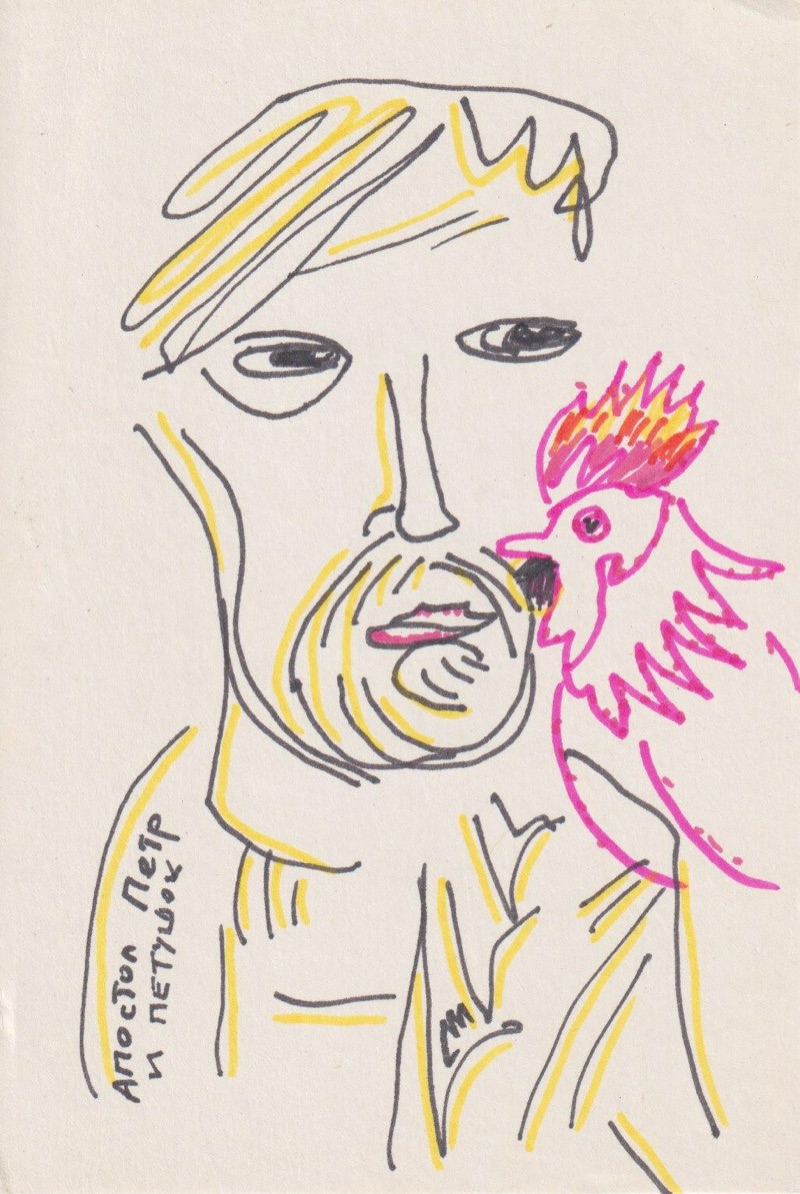
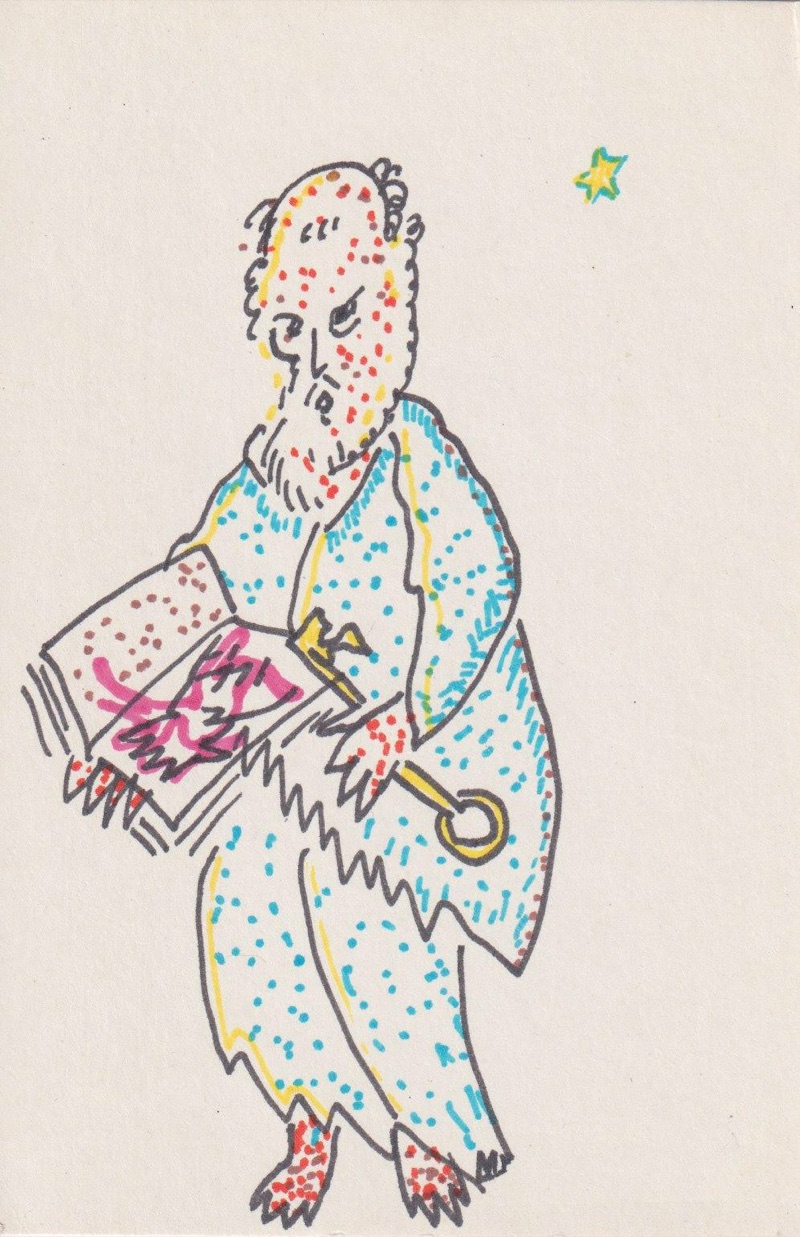
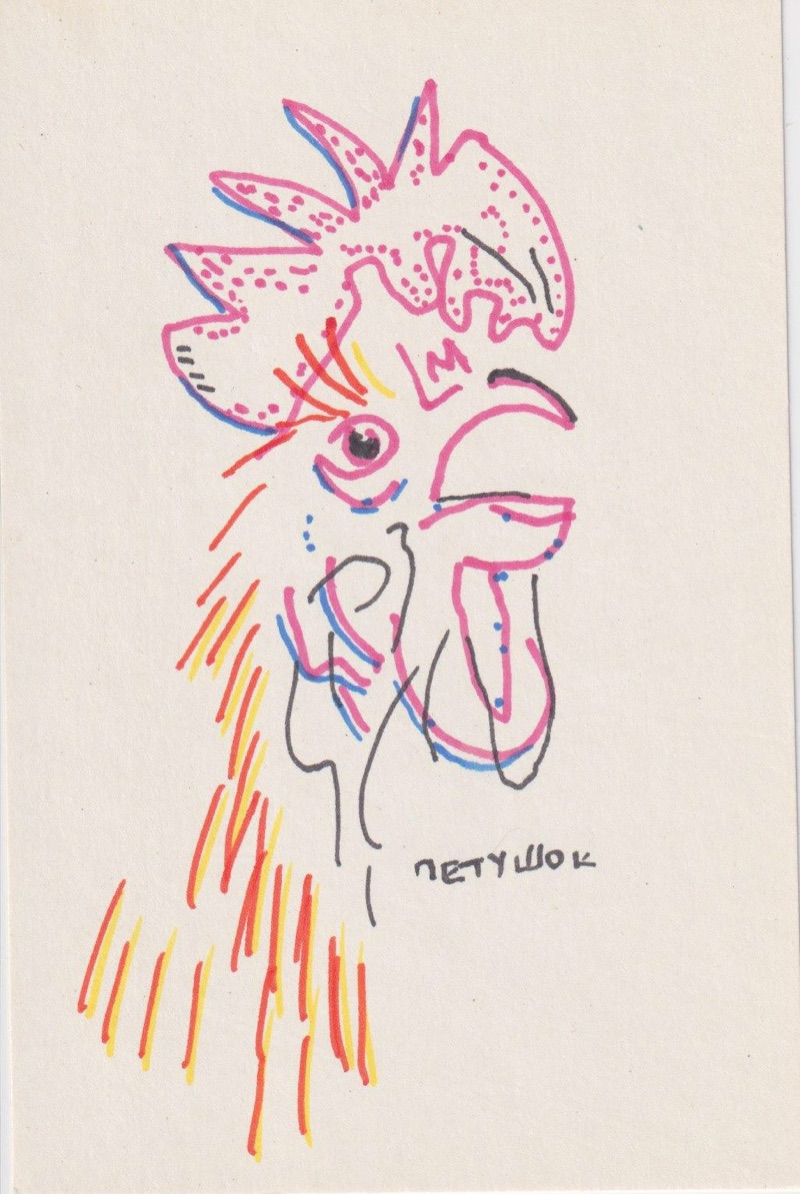
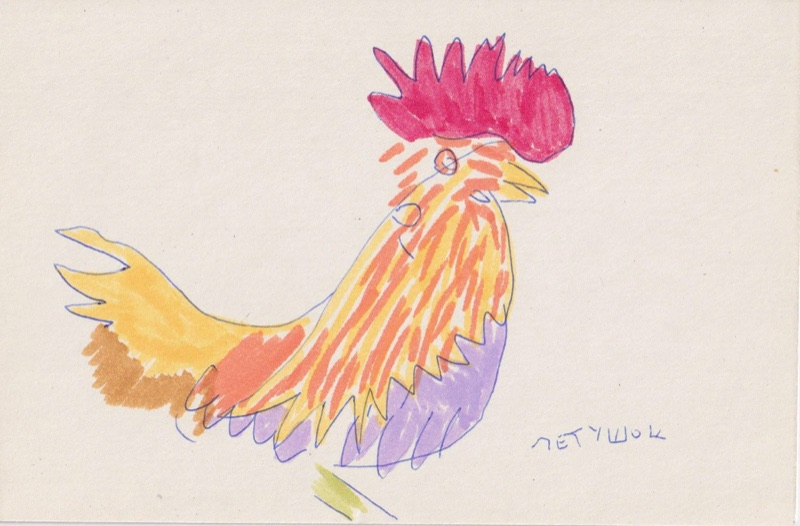
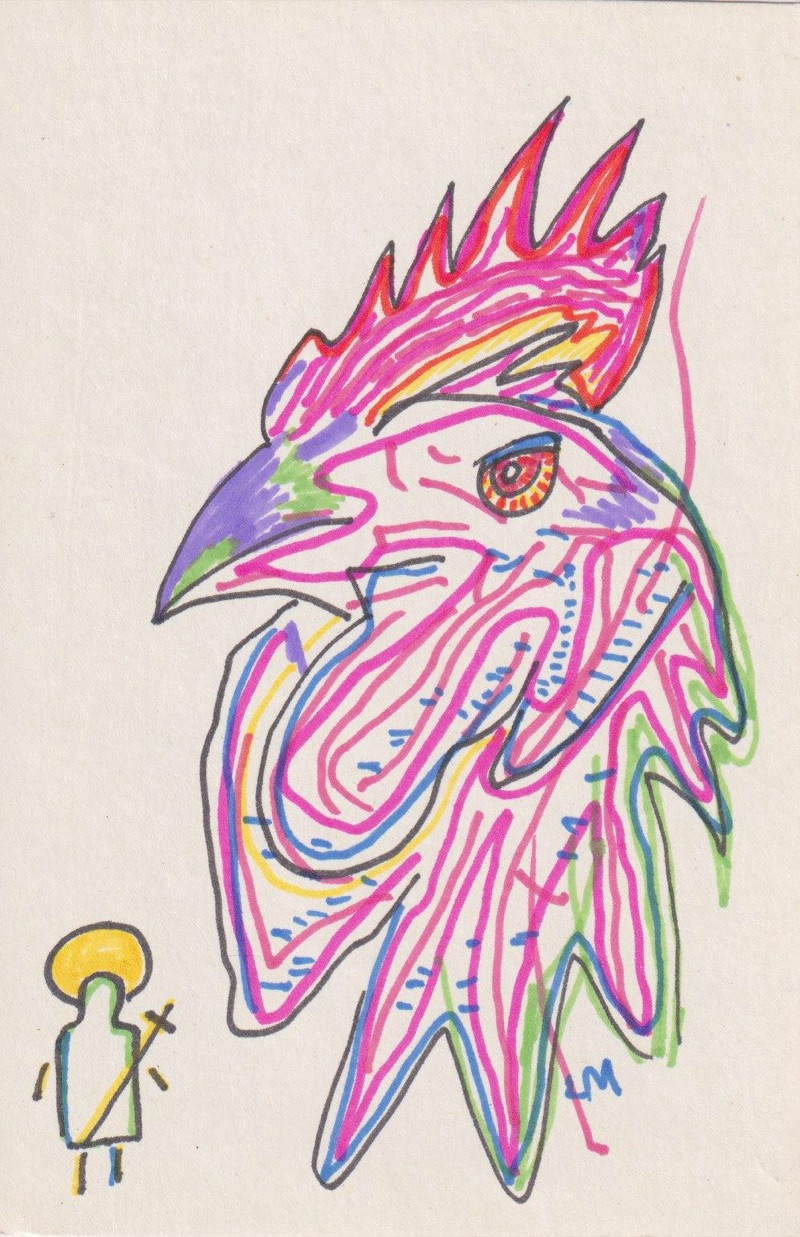
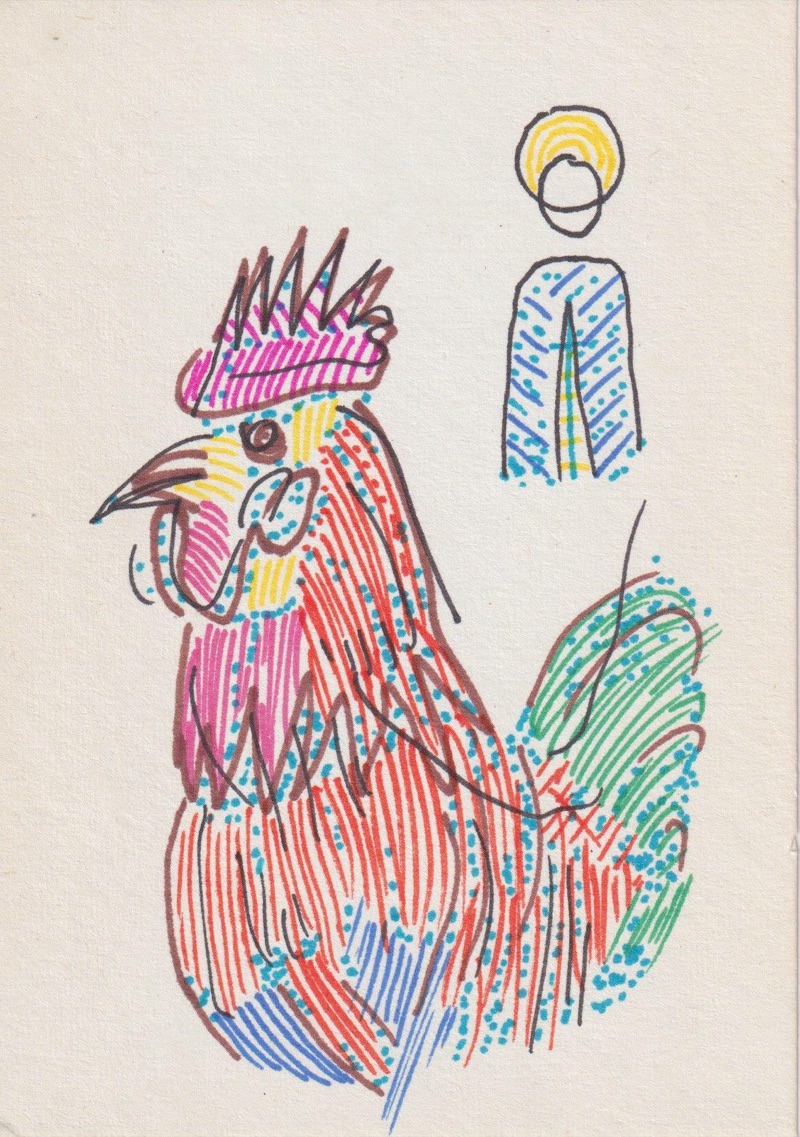
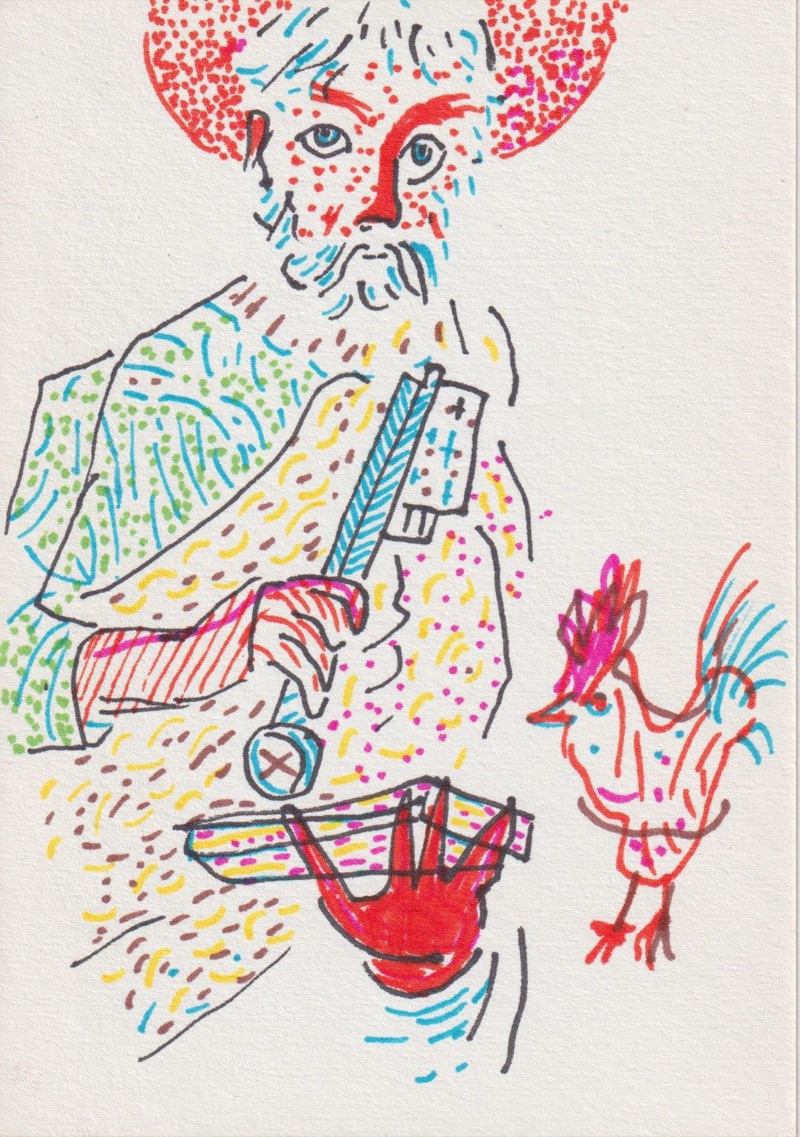
A series of ten postcards, drawn in September 2021. Text written in September 2026
The Subject
The rooster appears in every Gospel account of the denial (Matthew 26:69–75, Mark 14:66–72, Luke 22:54–62, John 18:15–27). Christ foretells that Peter will disown him three times before the rooster crows (twice, in Mark 14:30), and before morning it has happened. Luke adds a detail that is hard to forget: as the cock crowed, the Lord turned and looked at Peter (Luke 22:61).
For Christians this is not a story about a traitor. Peter was the closest of the disciples: he had openly called Jesus the Messiah (Matthew 16:16), and at the Last Supper he swore he would never deny him. Within a few hours fear broke that promise three times. But the story does not end there. After the Resurrection Jesus asks Peter three times, "Do you love me?" (John 21:15–17), once for each denial, and gives him back his place. Peter goes on to lead the apostles. So the story is read as one of repentance and forgiveness: even the one who failed worst was forgiven.
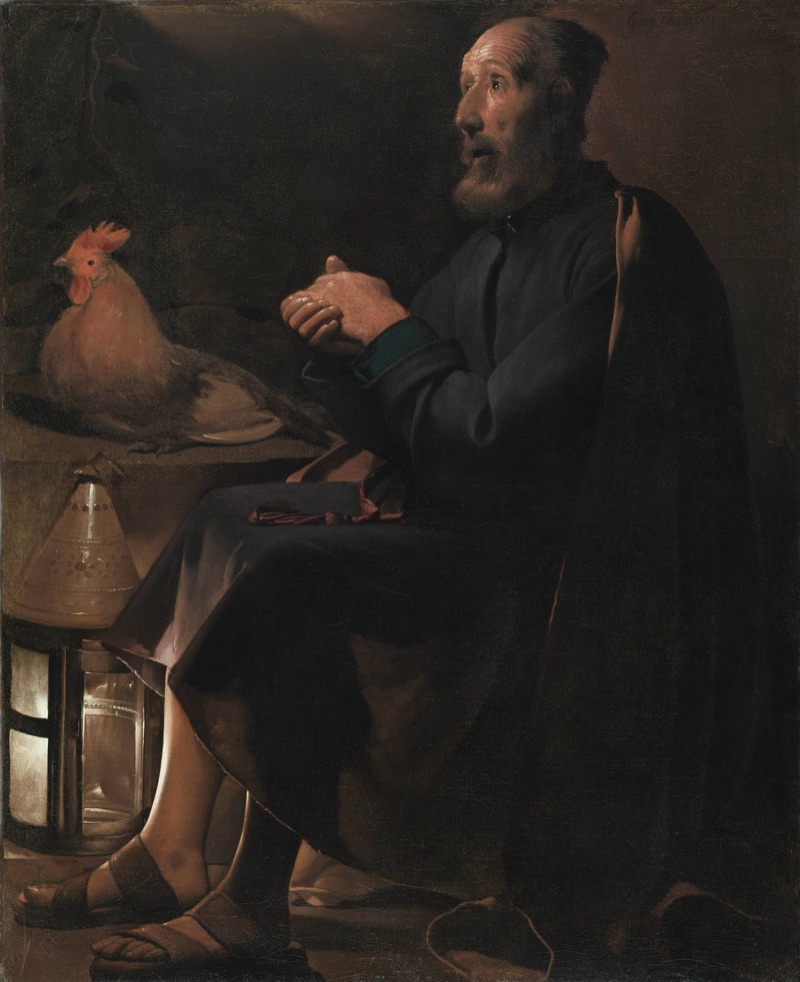
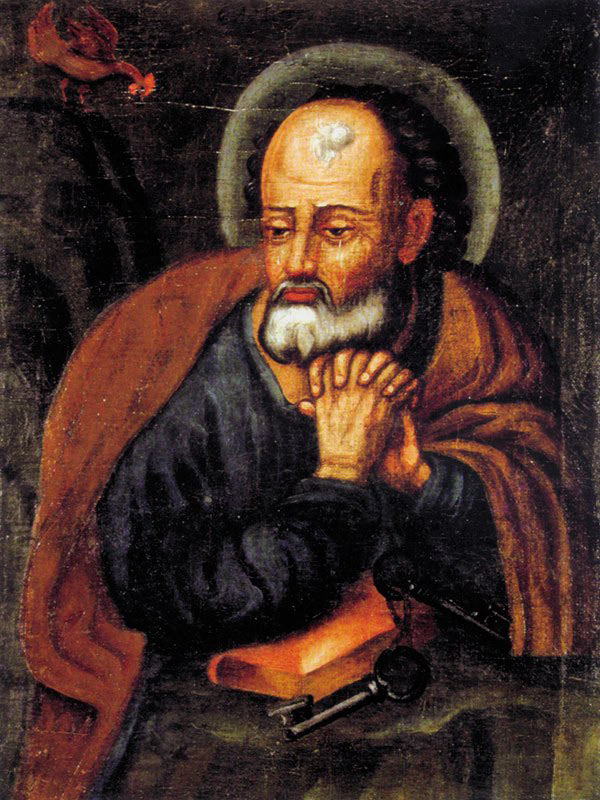
Peter and the rooster have been drawn together since the early centuries of Christian art, and the bird was never only a reproach. Fourth-century sarcophagi often show Christ foretelling the denial with a small rooster at Peter's feet. In the same century Ambrose of Milan wrote a morning hymn in which the cock's crow moves Peter to tears and washes away his guilt, so the voice that exposes him also announces the dawn. The ninth-century Chludov Psalter puts a huge rooster in the margin beside the weeping apostle; Balkan frescoes set it on a column above his head. After the Council of Trent the Tears of Saint Peter became a subject in its own right, with Peter alone, hands clasped, and the rooster close by, as in Georges de La Tour. Folk icons and reverse-glass paintings carried the pair into village homes.
In most of these works the rooster keeps to Peter's side, a quiet reminder of that night.
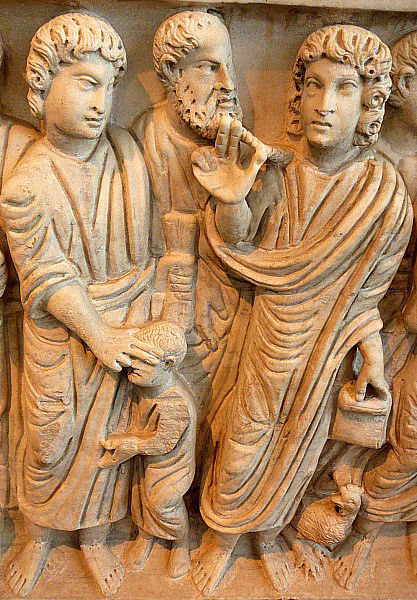
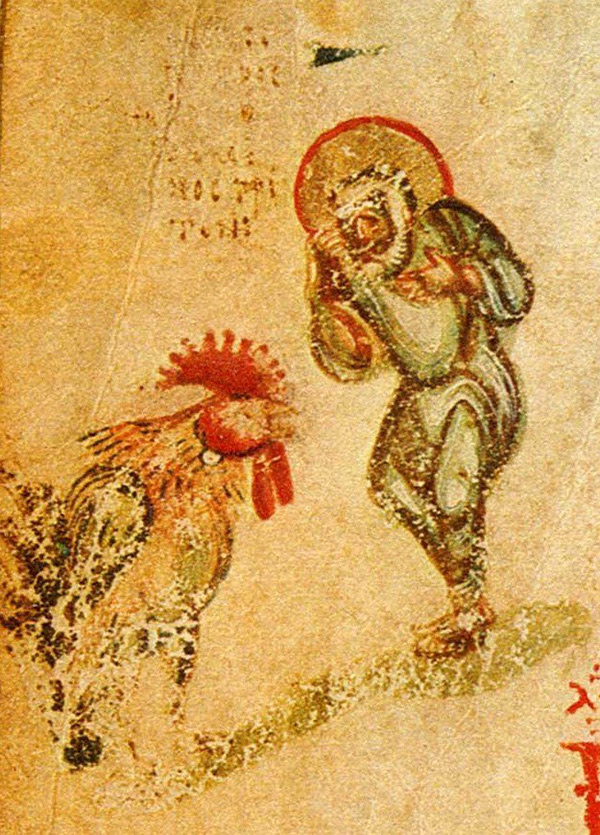
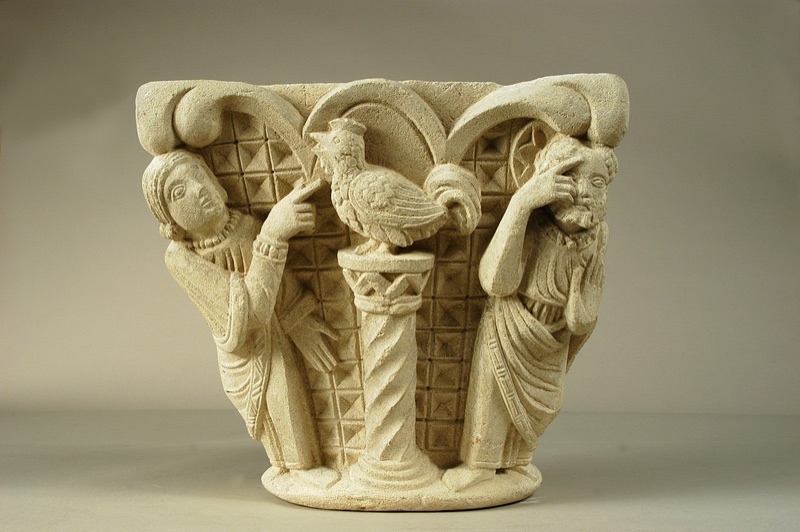
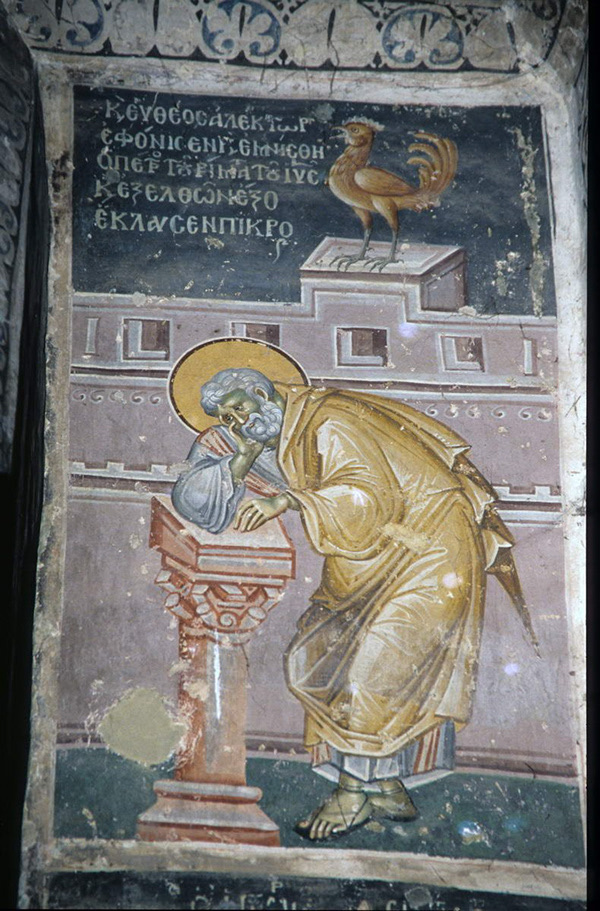
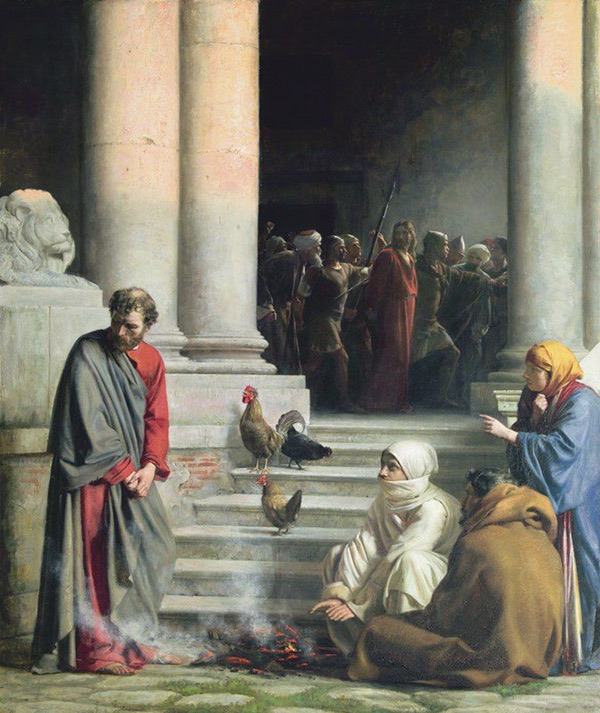
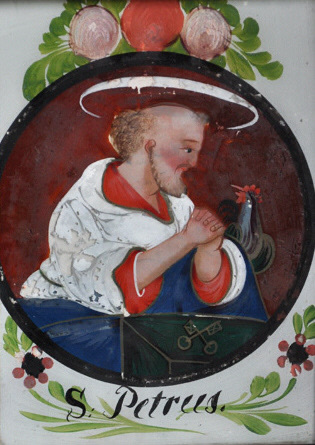
Left to right, top to bottom (all via Wikimedia Commons):
1. Sarcophagus of Marcus Claudianus, c. 330–335, Palazzo Massimo, Rome. Photo: Dick Stracke, CC BY-SA 3.0.
2. Chludov Psalter, mid-9th century, State Historical Museum, Moscow. Public domain.
3. Romanesque capital with the denial of Peter, Basilica of Saint-Sernin, Toulouse (Musée Saint-Raymond). Photo: Daniel Molinier, STC, Ville de Toulouse, CC BY-SA 4.0.
4. Michael and Eutychios, fresco, 1317, St George's Church, Staro Nagoričane. Public domain.
5. Georges de La Tour, Saint Peter Repentant, 1645, Cleveland Museum of Art. Public domain.
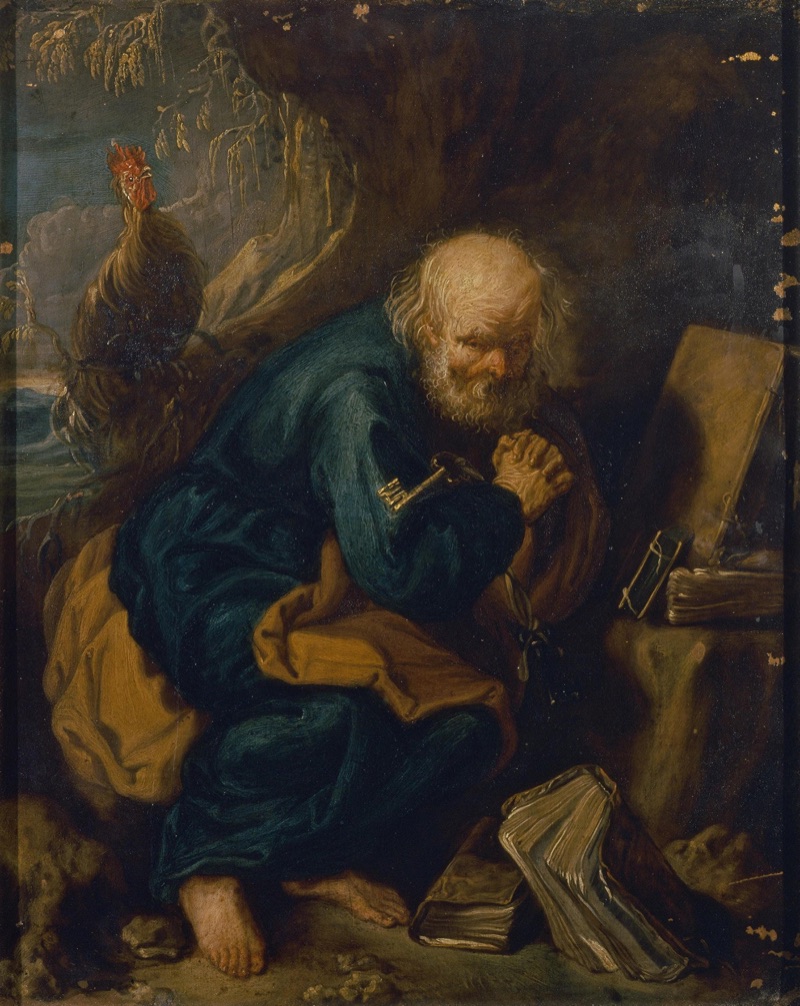
6. Simon de Vos, St Peter, 1630s, State Hermitage Museum. Public domain.
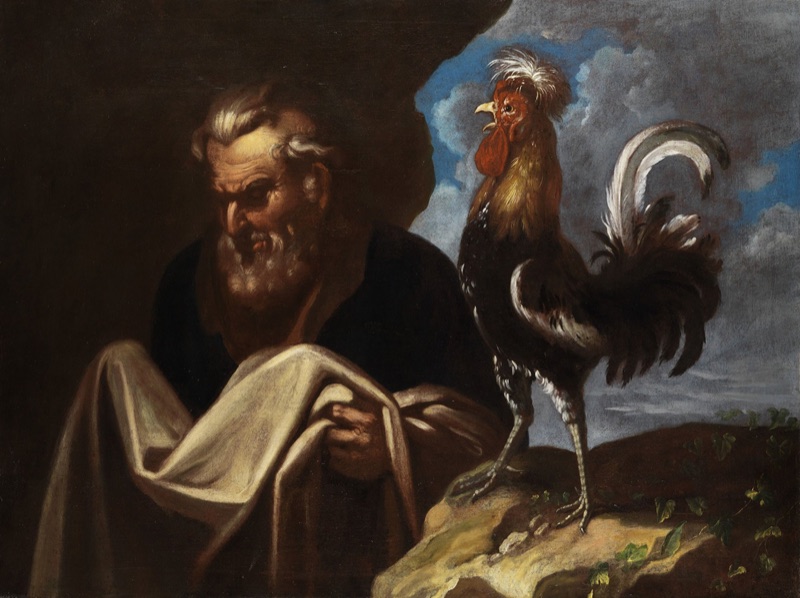
7. Attributed to Petr Brandl, Peter with the Rooster, 18th century. Public domain.
8. The Repentance of Peter, folk icon, early 19th century, Museum of Old Belarusian Culture, Minsk. Public domain.
9. Carl Bloch, The Denial of Peter, Frederiksborg Palace chapel. Public domain.
10. Saint Peter, reverse glass painting, Oberammergau, first half of the 19th century. Public domain.
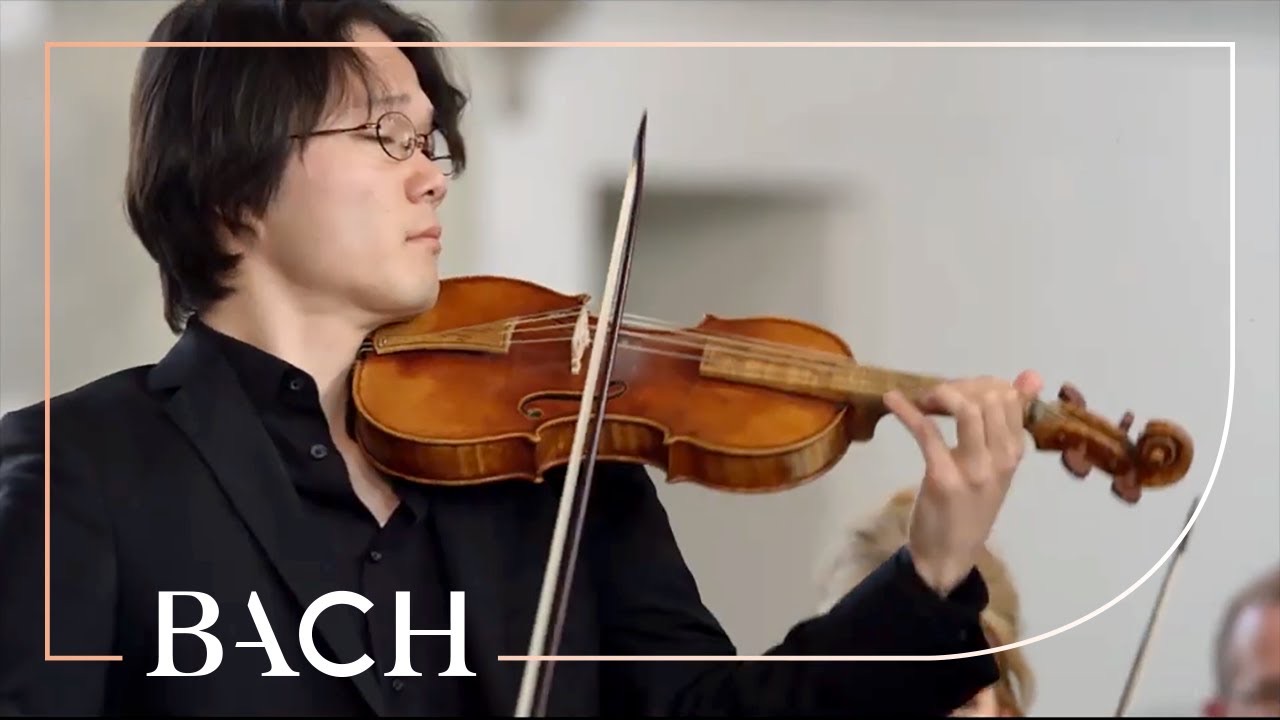
J. S. Bach, St Matthew Passion: "Erbarme dich", sung right after Peter weeps. Netherlands Bach Society.
Cinema has kept the scene too. In Pasolini's The Gospel According to St. Matthew (1964) Peter is played by a non-professional, Settimio Di Porto. Zeffirelli's Jesus of Nazareth (1977) and Gibson's The Passion of the Christ (2004) stage the denial in full. In the 1979 film Jesus, which follows Luke, the rooster crows and Jesus turns to look at Peter.
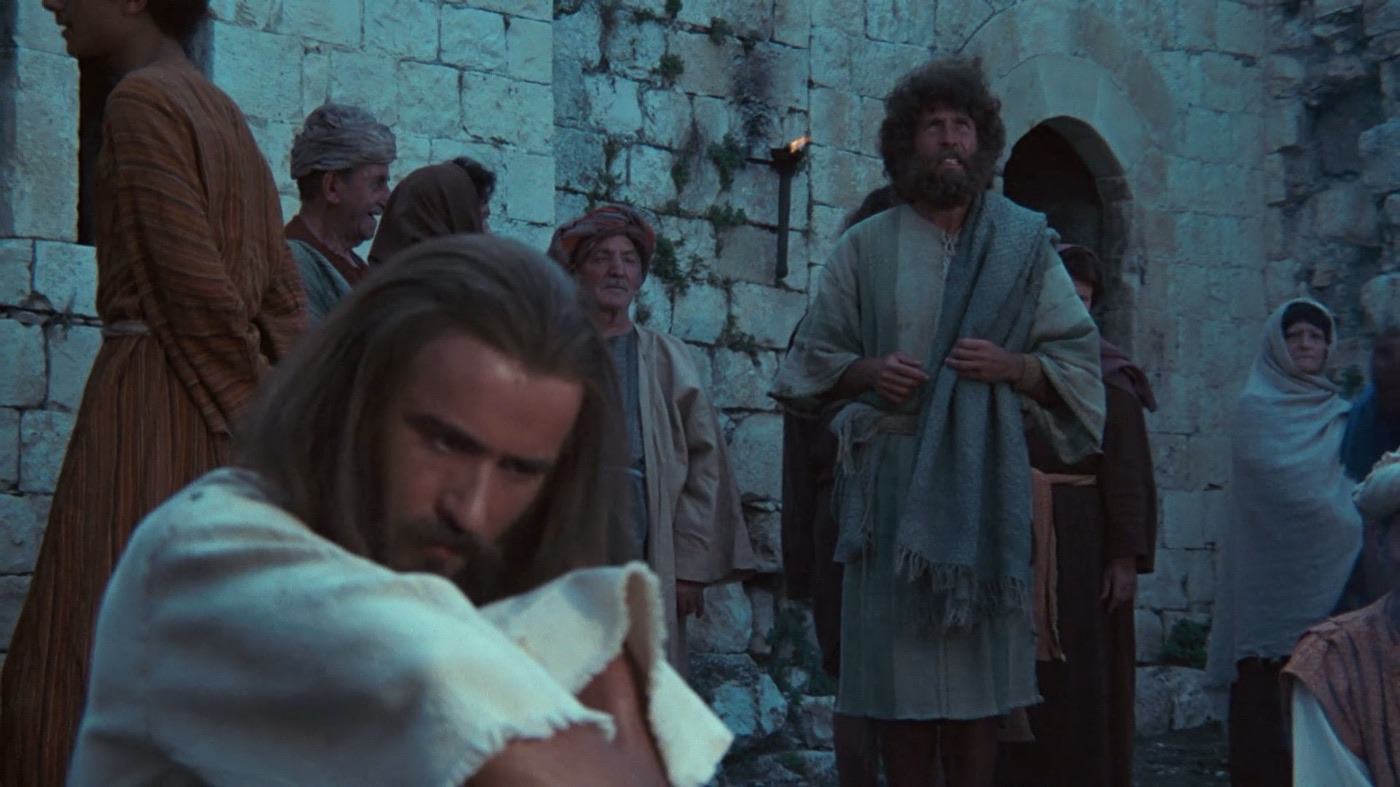
Peter hears the rooster crow. Jesus (1979), directed by Peter Sykes and John Krish. Still from the Jesus Film Project.
About the Series
In the overhead cupboard of a flat I rented on Favorsky Street I found a Soviet-era pad of small pre-cut sheets of coated drawing paper, forgotten there for years. I liked them at once: the paper had a pleasant velvety surface and a soft, warm tone, and I wanted each sheet to hold one compact scene. On a September evening in 2021 I filled ten of them with a single story: Peter's denial and the rooster.
I wasn't following any specific image. I wanted to retell the story the way a child sees it, with a half-naive eye, as I first met it myself: in an illustrated children's Bible at home.
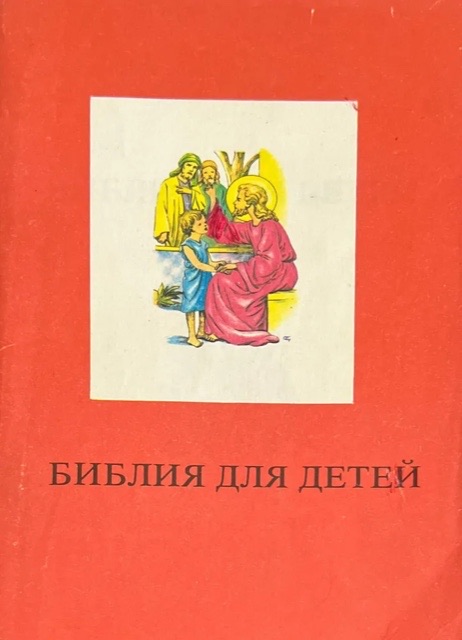
The children's Bible I had at home, a thin paperback from the early 1990s. I don't remember whether it told of Peter's denial. What mattered more came next: I read the Gospels in a full Bible, and they astonished me.
I was born and grew up in Saint Petersburg. Peter the Great named the city after the apostle Peter, his patron saint, and the apostle is still one of the city's protectors. My father left the family when I was small, and I grew up without him. Somewhere in childhood the apostle of my city became something like a father figure to me. Perhaps that is part of why this story stays with me: my father's leaving was a denial too — of us.
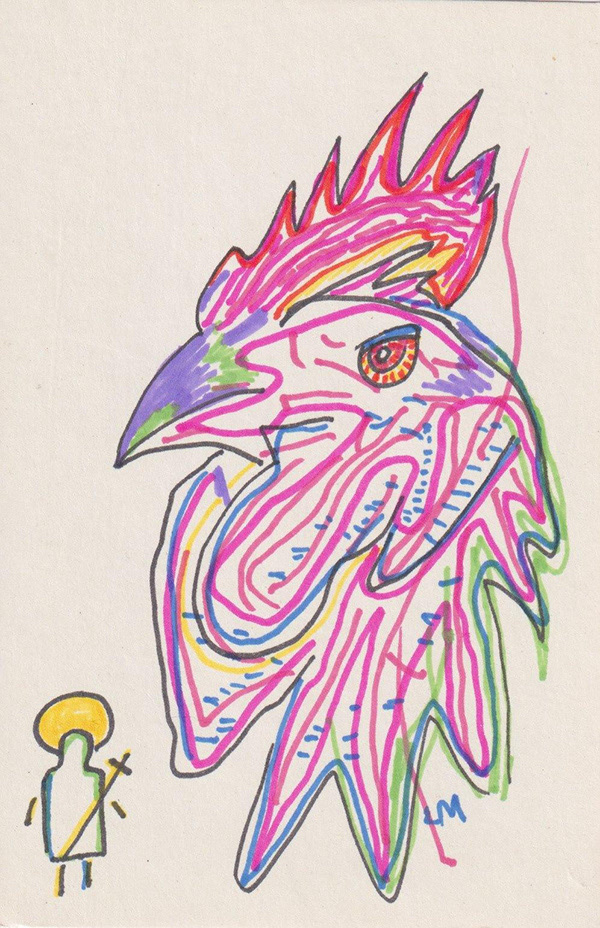
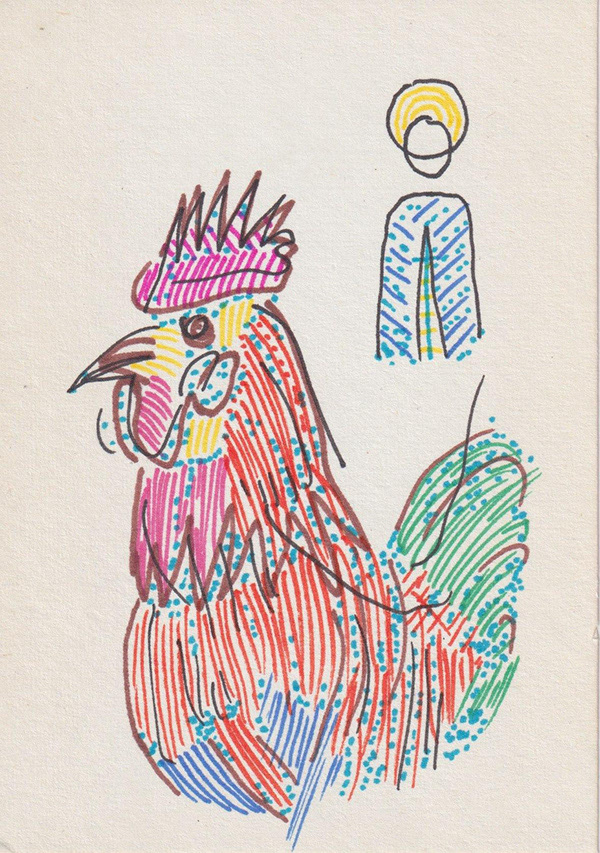
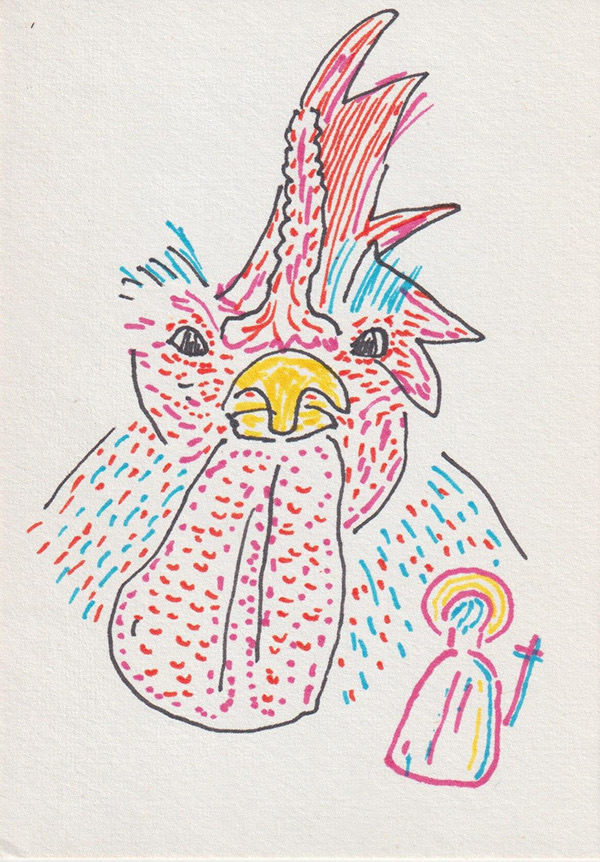
I drew the cards first. Only later did I notice that the ten of them fall into four chapters: three, three, three and one. The means stay the same from card to card — markers, line, dot — while colour and composition find a new balance each time.
I. The Rooster
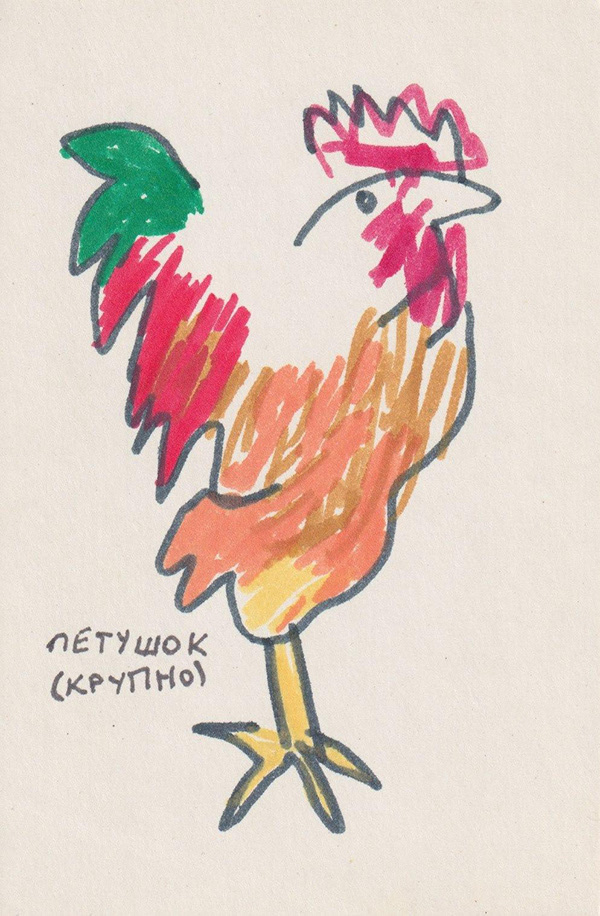
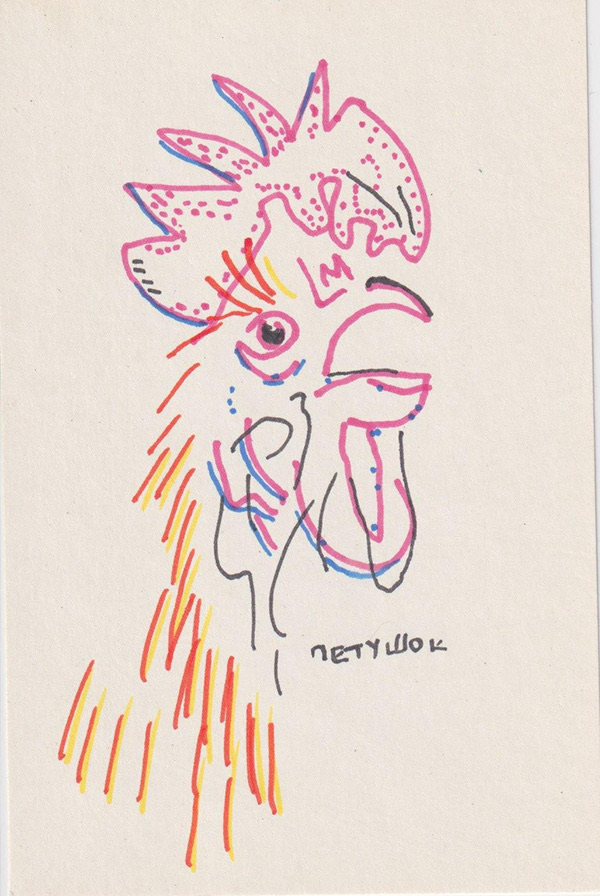
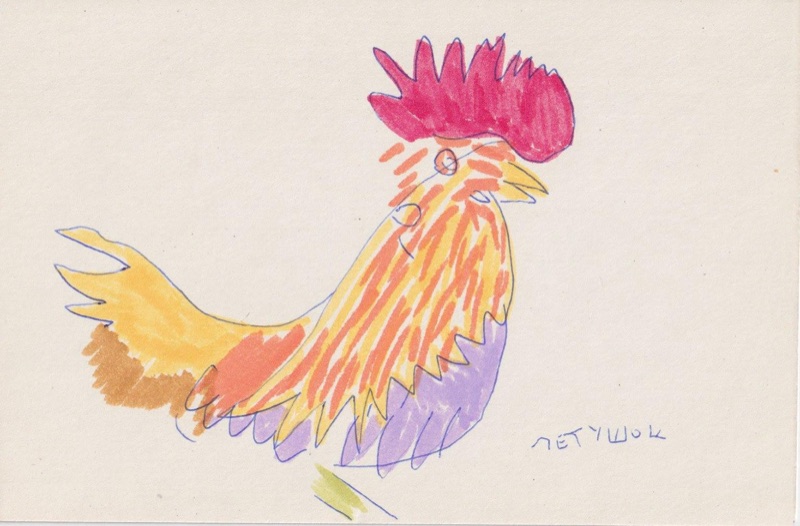
For a child, the rooster is the easiest part of the story to hold on to. A saint is hard to picture; a bird that crows at exactly the right moment is not, and three denials followed by a crow sound like the refrain of a fairy tale.
All three cards are signed by hand «Петушок» — petushok, the affectionate diminutive a Russian child uses for a rooster. The word softens the scene: the bird that marks the denial steps out of a nursery rhyme. For me it also echoes Petrushka, the Russian puppet, as if he had split in two: the human half became Saint Peter, the bright, motley half became the rooster. Perhaps that is where the colours came from.
II. The Rooster and the Saint
Here Peter only just appears: a small figure beside the rooster, and only a halo — and on two of the cards a cross — hints that it is him. The roles are reversed: usually the rooster is Peter's attribute, but on these cards Peter becomes the rooster's. That is how a child weighs things: the big, bright, loud bird matters more than the quiet man next to it.
III. Peter and the Rooster
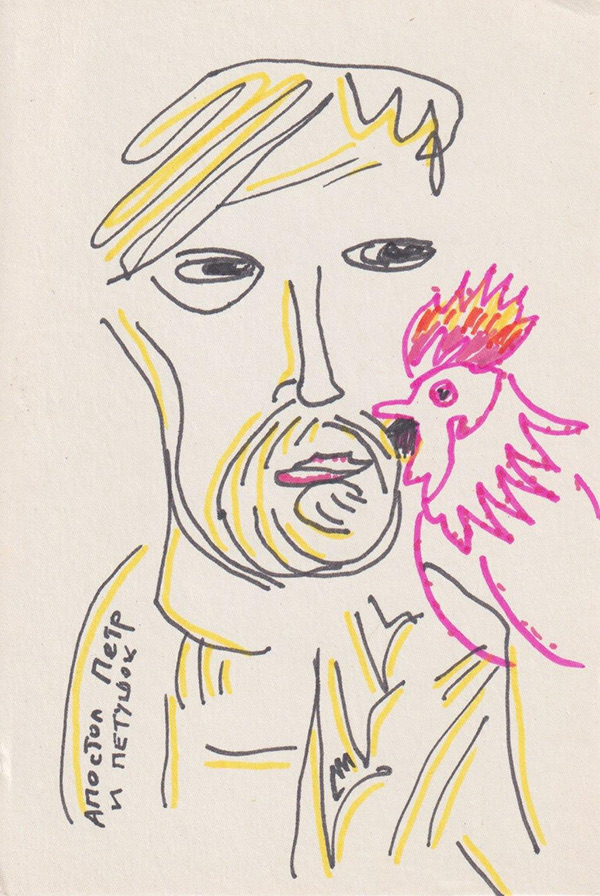
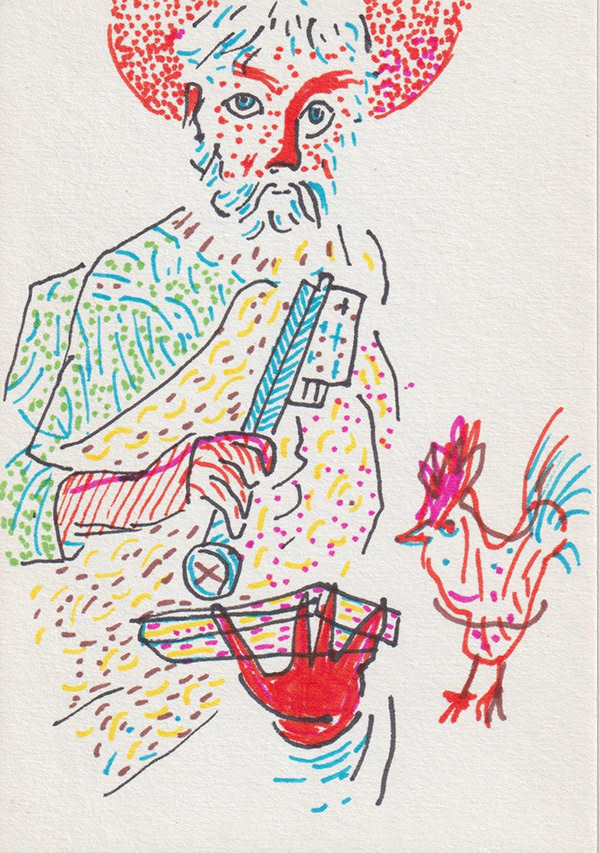
Peter and the bird side by side, and three quite different Peters, one for each denial. The first is frontal and iconic, with a large halo and a cross-staff. The second is reduced to line. A yellow contour slips off the black one, the halo is gone, and he looks like a man of today; a bright pink rooster stands to his right. The third is built from dots and short dashes, almost like a mosaic, and the rooster next to him is drawn as simply as a child would draw it. Looking at them now I can see echoes of icons, of modernist line drawing, of pointillism — but that evening I was only following the paper.
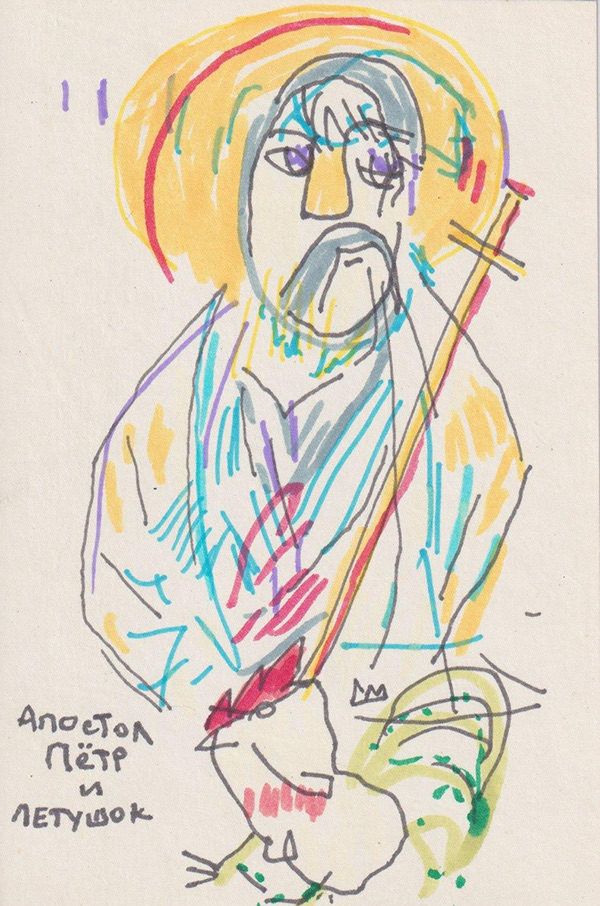
IV. Peter, the Rooster in the Book, and a Star
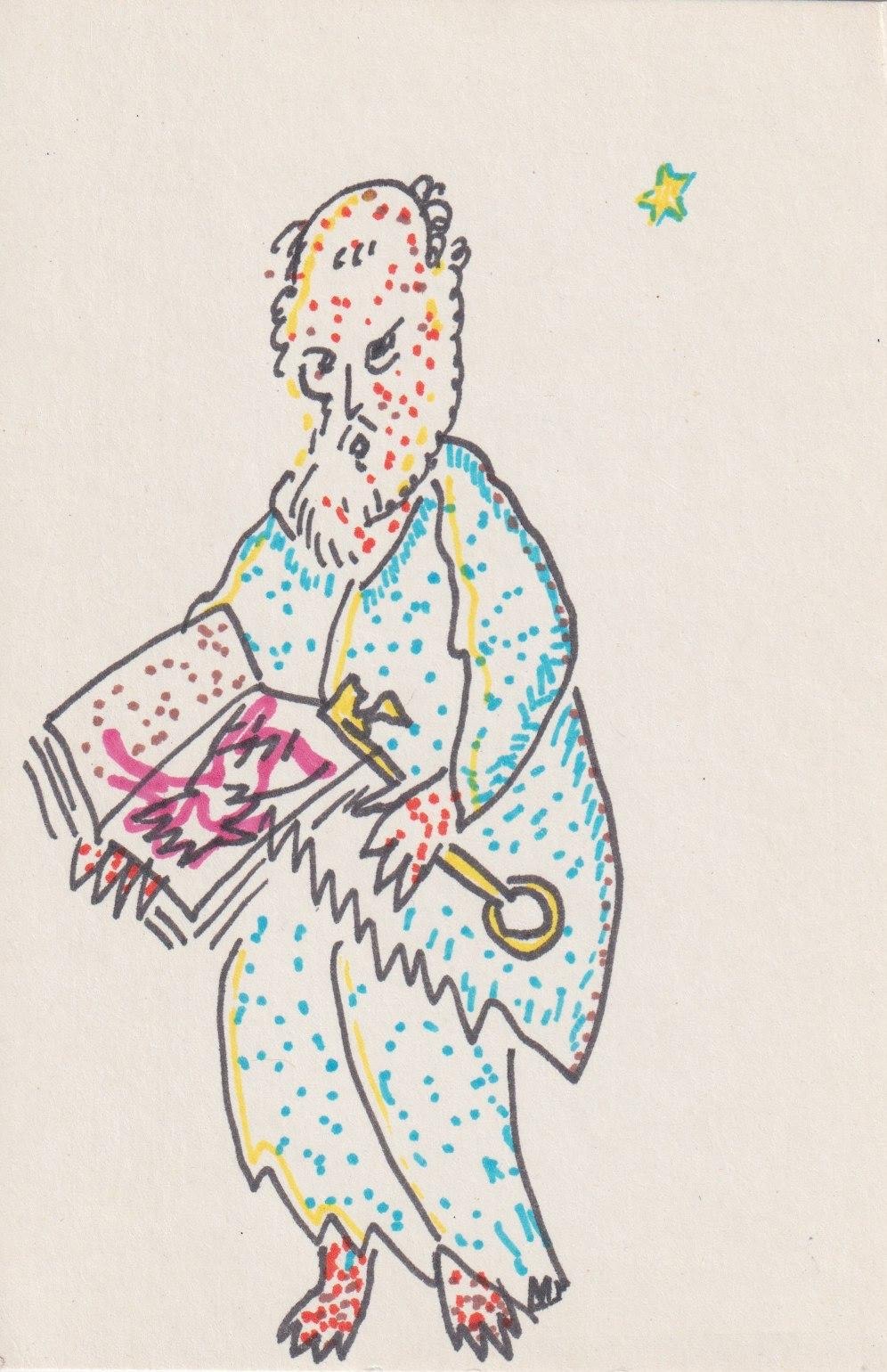
My favourite. Peter is reading a book with a petushok in it: a children's Bible, with his own story inside. His outline and the little star above him make me think of the Little Prince: what if he had never met the snake, and had grown old, and looked like this?
The uneven handwritten inscriptions and the deliberately simple shapes speak in one voice — the Bible as a child remembers it. The Russian neo-primitivists, Larionov and Goncharova, and the old lubok, Russian popular prints with homely captions, looked at the world in much the same way.
Epilogue: Kovchezhets (Russian: Ковчежец)
I have also come back to this story in a poem, published in my Telegram channel. Below are the Russian text and a word-for-word English version.
It rests on a pun. Petya, the pet name for Peter, is also what Russians call a rooster, because it echoes petukh, the Russian word for one. It amuses me that the coincidence falls to the apostle Peter of all people: the saint and the bird share a name, and on the cards they keep reflecting each other.
The poem also moves through words ending in -u: agu (a baby's first coo), umru ("I will die"), ugu ("uh-huh"), ku-ka-re-ku, ra-ku (a reliquary).
Ковчежец
Вначале было слово, и слово было «агу».
Через четыре буквы [кажется] я «умру»: считать ли за единственную букву повто́ренное «у _ _ у»?
Через три буквы, две буквы, через одну — станцию — вы-выходите? — выдавите хотя бы «угу»...
Двери метро вперяются в темноту, совы не оперяются: ни гу-гу, и ни бе, ни, так скажем, ме, ни даже три торжественных ку-ка-ре-ку...
Сон в руку, в реку, египетскую ра-ку.
Петя-Петя, неужели ты навсегда отрекаешься?
Translation
The Little Ark [kovchezhets: a small ark, also a reliquary]
In the beginning was the word, and the word was "agu" [a baby's first coo].
Four letters later [it seems] I "will die" [umru]: should the repeated "u _ _ u" count as a single letter?
Three letters later, two letters, one — a station — are you get-getting off? [the everyday question in a crowded metro car] — squeeze out at least an "ugu" ["uh-huh"]...
The metro doors stare into the darkness, the owls do not fledge: not a peep [ni gu-gu], neither "be" nor, let us say, "me" [ni be ni me: not a word], nor even three solemn cock-a-doodle-doos [ku-ka-re-ku]...
A dream into the hand [a dream that comes true], into the river, into the Egyptian re-li-qua-ry [ra-ku: raka, a shrine for relics; the split also gives Ra].
Petya-Petya, are you really renouncing forever?
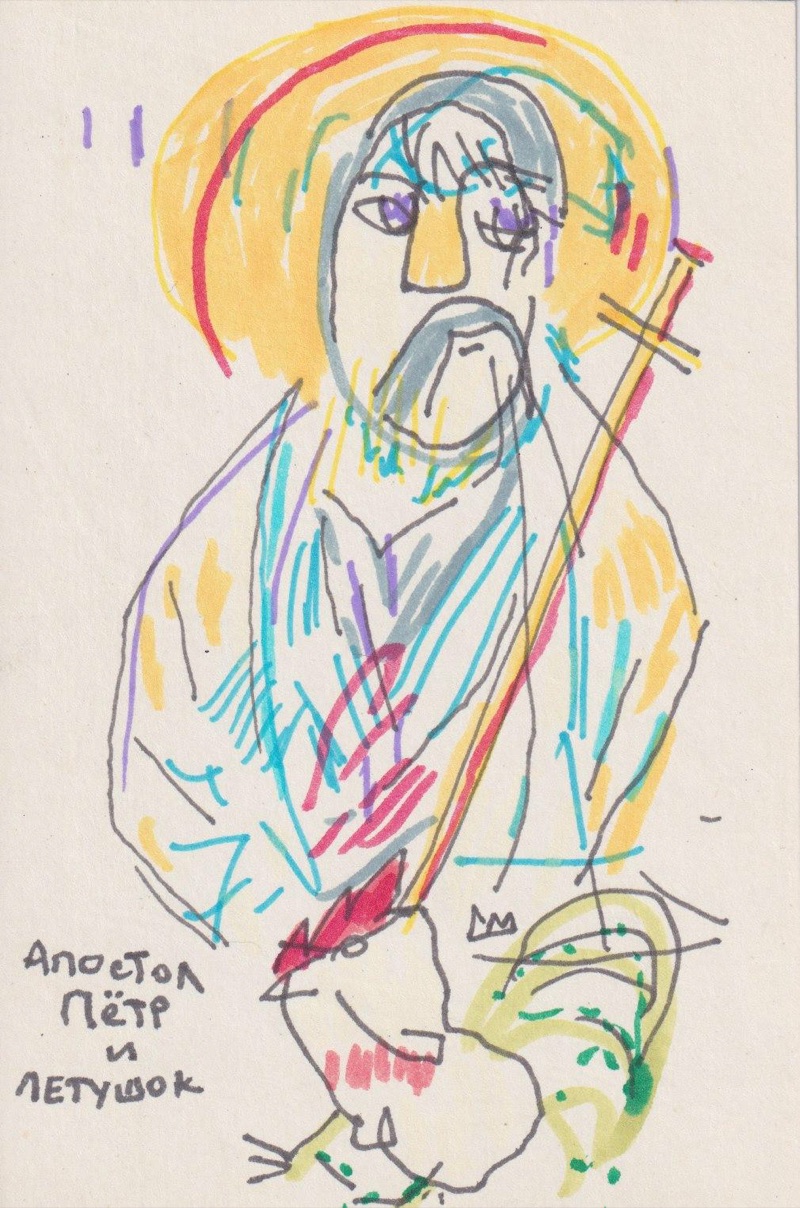
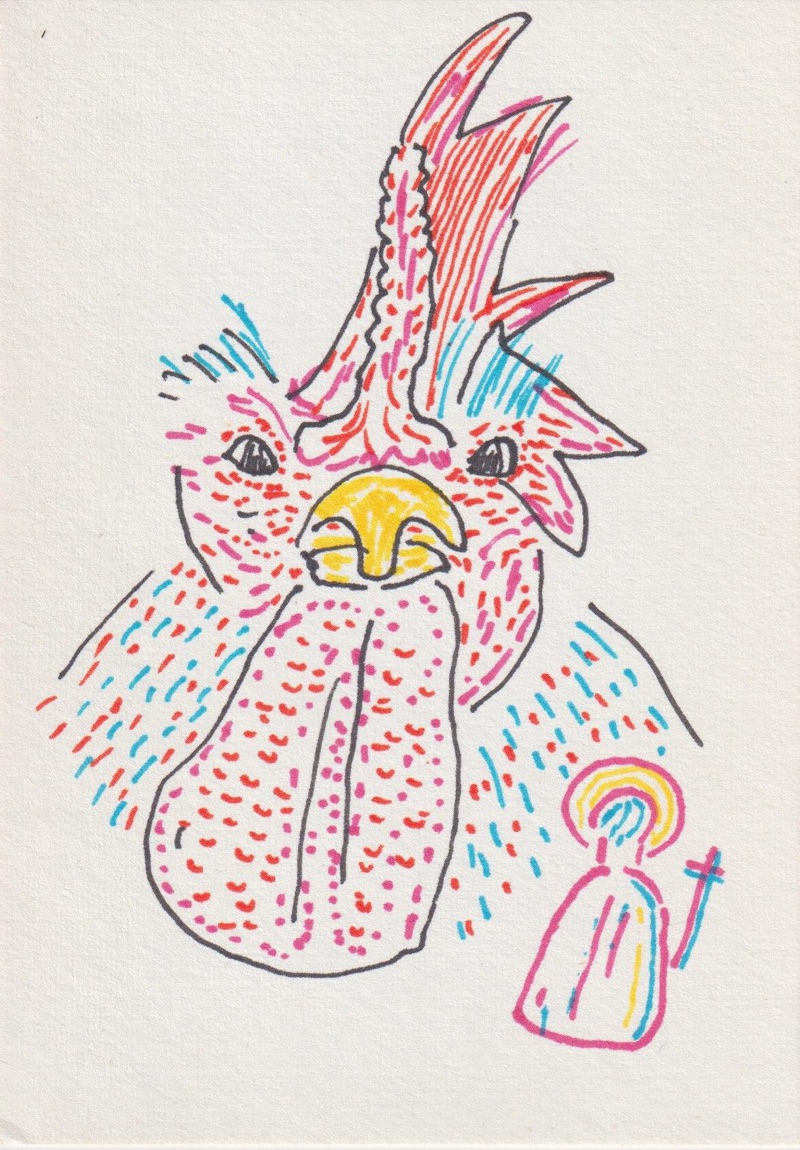
Markers on coated paper, 85×130 to 100×145 mm. September 2021.
Further Reading
• Robin M. Jensen, Understanding Early Christian Art. Routledge, 2000; 2nd ed. 2024.
• Ambrose of Milan, hymn Aeterne rerum conditor, 4th century.
• Brian P. Dunkle, Enchantment and Creed in the Hymns of Ambrose of Milan. Oxford University Press, 2016.
• Kathleen Corrigan, Visual Polemics in the Ninth-Century Byzantine Psalters. Cambridge University Press, 1992.
• Kurt Weitzmann, The Monastery of Saint Catherine at Mount Sinai: The Icons, vol. 1. Princeton University Press, 1976.
• Gertrud Schiller, Iconography of Christian Art, vol. 2: The Passion of Jesus Christ. Lund Humphries, 1972.
• Émile Mâle, L'art religieux après le Concile de Trente. Armand Colin, 1932 (full text on Gallica).
• Jane Ashton Sharp, Russian Modernism between East and West: Natal'ia Goncharova and the Moscow Avant-Garde. Cambridge University Press, 2006.
• Jonathan Fineberg, The Innocent Eye: Children's Art and the Modern Artist. Princeton University Press, 1997.
• Anton Chekhov, The Student, 1894 (translated by Constance Garnett).